Arthur Steenhoudt
Portfolio
2025
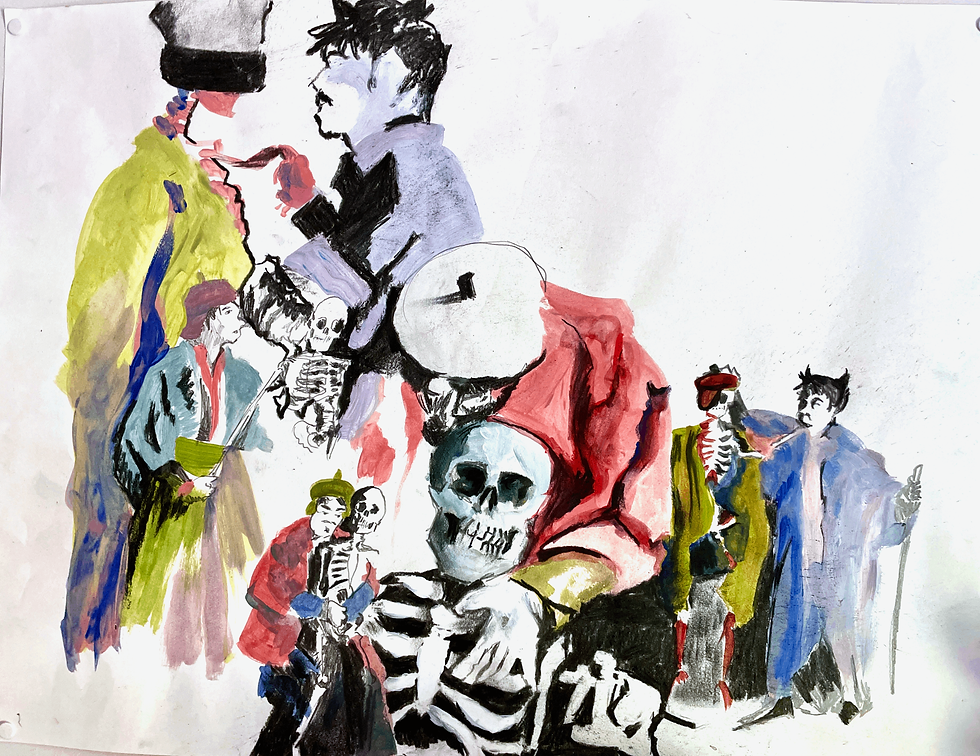
JEALOUS ARLETTE
- in dev
“Love begins when you dare to show your skeletons.”
“She thought she would find a rival.
She found four skeletons.”

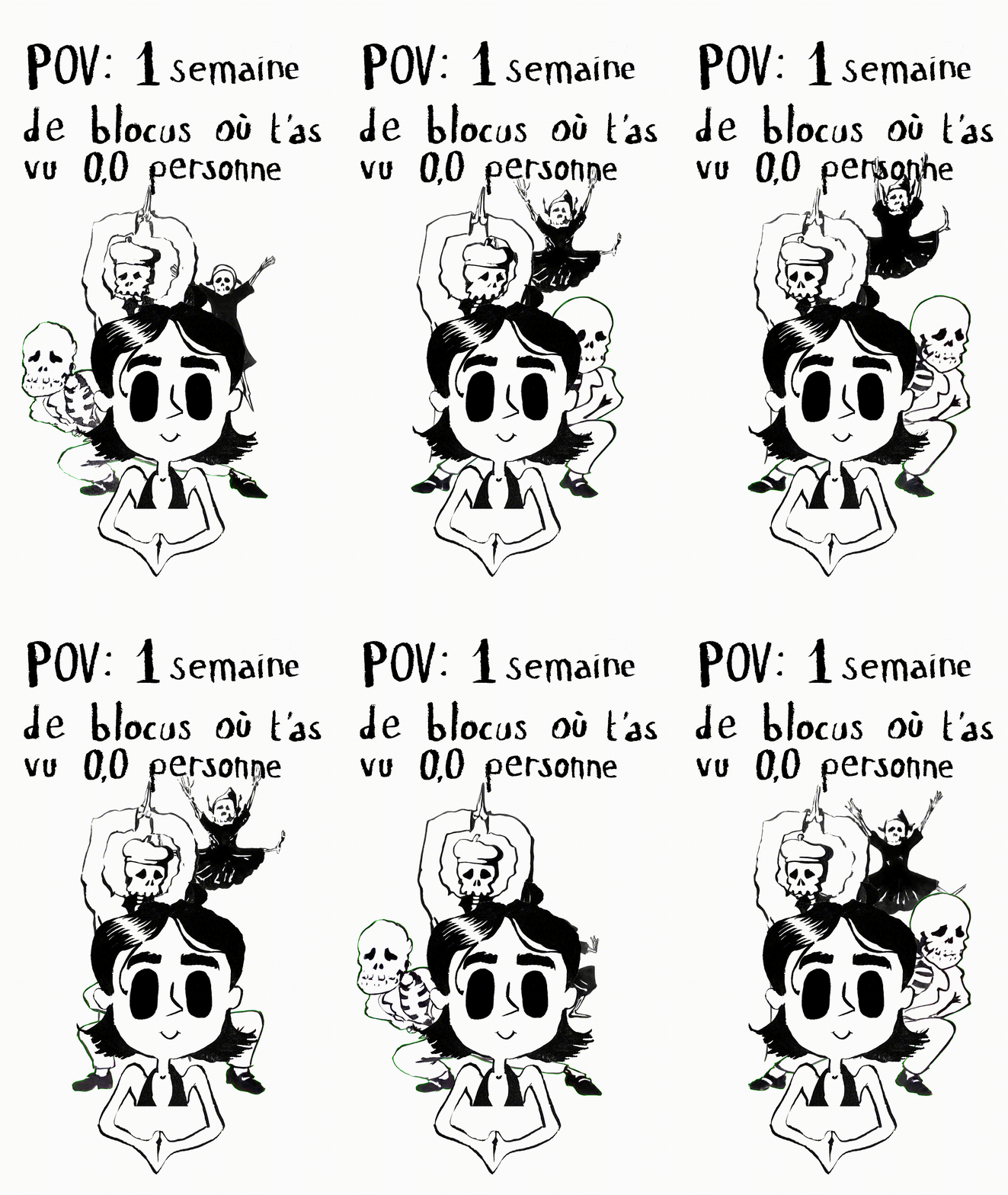
Arlette, a curious young girl, falls in love with Emile during a costume party. But he suddenly runs away, and Arlette, thinking he’s going to meet another woman, follows him to his home. She discovers that he isn’t hiding a lover, but his skeletons in the closets. Except that she also has hers — kept safe in her bag.
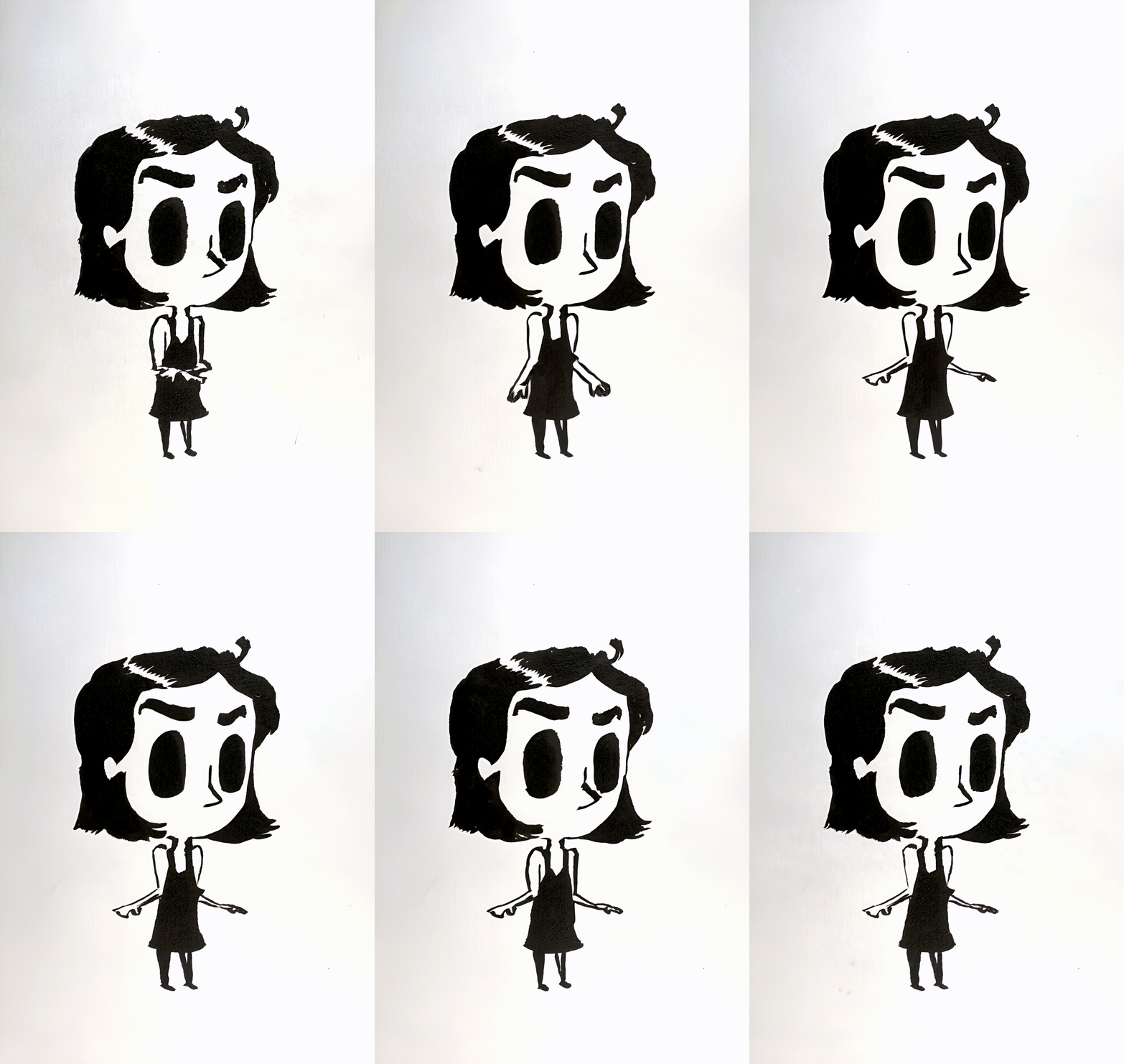
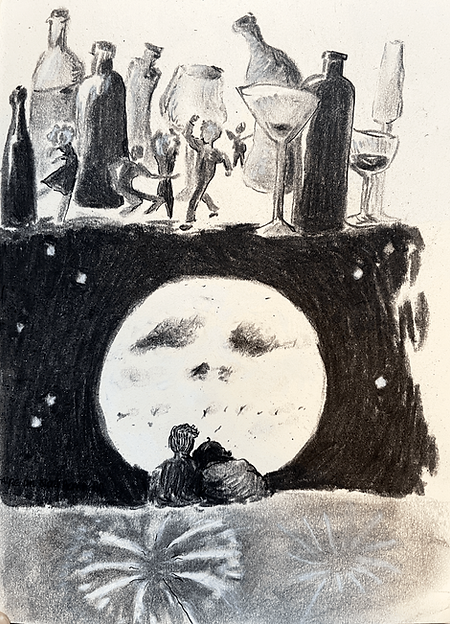
It’s winter. Emile leaves his house in a rush, not closing the door properly. He heads to a costume party in a chalet. Among giant bottles and people in costumes, he dances wearing his mask, but he’s looking for someone. Arlette, a young girl dressed as a devil, is also looking for someone. Emile gives up and steps outside the chalet. Outside, Arlette joins him. He tries to keep his mask on, but she reveals his face. They’re happy to see each other and, hesitant, they exchange a timid kiss on the cheek. Arlette removes her devil horns. She’s cold, he puts his coat on her shoulders. Under the full moon, their faces grow closer. Fireworks burst.
Arlette goes back inside for a moment. Alone outside, Emile stares at the Moon when a drunk man wearing a skull mask startles him. Inside, Arlette is wearing Emile’s coat on her back. As she picks up her bag, she discovers a gold bracelet with red beads falling from the coat. Her face darkens with anger in the bathroom mirror. She steps out: Emile has vanished. She sees him in the distance before he turns toward her, while she hides, panting behind the door, gripping the bracelet.
SYNOPSIS

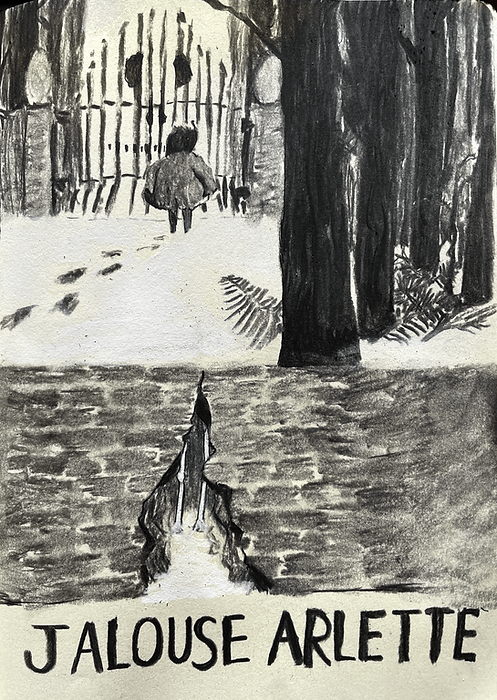
Arlette follows his footprints in the snow through a field of enormous trees. She glimpses a feminine shadow and follows it. She reaches a huge closed gate. On the wall next to it, a golden plaque reflects her face with devil horns. She first reads: “Emile, the two-faced jerk and his fiancée.” But we see: “Emile Lautruche & Associates.” She sees another shadow slip toward a crack in the wall nearby. Furious, she squeezes through it. Inside: a cavern filled with mirrored cabinets. She sees a scarf fluttering into a dark gallery. She runs after it. What is first a mirrored corridor narrows. She crawls through a tunnel up to a well where a ladder stands. A trapdoor opens on its own. At the top, she steps onto creaking floorboards. Emile shouts, “Arlette?” She hides inside a closet.
Through the slats, she sees a gigantic skeleton walk by. Panicking, she forces the door open, shattering a mirror, and flees up the stairs, pursued by white, bony silhouettes. She climbs to the upper floor and takes refuge in a room with an open balcony. We hear: “Arlette, no!” Bony arms reach toward her. She backs up and falls into the void.
Emile catches her, himself held by skeletons clinging to one another. The sun rises. The hand of the last skeleton slips. They fall into a puddle of mud two centimeters below them. They burst into laughter. Three skeletons rush over to help them, dressed in ridiculous clothing in Emile’s colors. Emile makes a last attempt to hide them, but Arlette opens her bag: she takes out three small childlike skeletons, alive as well, dressed in Arlette’s colors. Emile and Arlette look at each other tenderly — smiling, connected.
what ?
Inspiration and world
“Having skeletons in the closet”: this is what inspired the story that brings these skeletons to life. Snow, a manor house, and skeletons: this is the world in which Émile and Arlette evolve.
Reunion of the characters
Émile and Arlette already know each other and meet again at a party, as often happens. The people at the party are in costumes and masked to highlight the film’s central question: to reveal oneself or not. Émile is looking for someone (Arlette), and Arlette is also looking for someone (Émile). It’s the kind of party you go to in the hope of seeing the person you have feelings for.
Émile is attentive and reserved: he hides behind a small mask. Arlette is curious (she removes Émile’s mask), sincere (she hides less), and above all, jealous. The two seem to know each other but hesitate over how to say hello. Should they hug? Kiss on the cheek? Maybe they’ve already shared moments together, but in any case, they are not “together.” Émile teases Arlette, suggesting their familiarity.
This first scene already captures the essence of the film thanks to the costumes: Émile wants to keep his mask on, meaning he doesn’t want to show himself as he truly is. Yet it is when Arlette reveals her true nature that the two can grow closer. This simple scene illustrates the entire film.
Émile and his secrets
Émile lives in a tall house he wants to keep tightly closed because, like all of us, he keeps his skeletons in the closets: the rough edges of our soul, our unconfessable eccentricities, our flaws, our smallness, our poverty.
Émile wants to hide his skeletons, which is why he flees from Arlette and prevents her from coming closer to him. Thus, when the drunk man from the beginning turns around and is actually dressed as a skeleton, Émile senses he may have forgotten to properly close the door of his house — and so his skeletons might be escaping. He immediately runs home.
Tension and jealousy
Coming out of the bathroom, Arlette wants to find the one with whom she shared such a beautiful moment, but she discovers the bracelet hidden in Émile’s coat: Émile has vanished into the night. She then begins to believe that he is hiding something and that there is another woman in his life. Crossing the snow and the cold, the tension builds as if we were following her.
Émile forgot to lock the door of his house — meaning: he left his heart slightly open, his skeletons threatening to escape. This must absolutely be prevented, otherwise, for Émile, it would be a disaster: everyone would see his flaws and imperfections. But perhaps one of the skeletons has already escaped? This threat intensifies every minute, pushing claustrophobia to a narrow tunnel and a dark closet. One escapes only by breaking a mirror — breaking the ice.
Arlette’s perception and obsession
Arlette sees reality through the prism of her jealousy. Some things that are clear and visible appear differently to her, while some visions emerge purely from her imagination.
She believes she is tracking down a rival and follows her underground into a hall of mirrors.
When she reaches the house, the pressure is at its peak, and Arlette ends up discovering in terror the monsters that live there.
Finally, she understands who the bracelet belonged to: one of the skeletons.
why ?

Revelation and love
Arlette carries her skeletons in her bag. It is when she shows them to him that Émile understands: true love exists only when we reveal our flaws and weaknesses to one another — echo of the reunion scene: Arlette pushes Émile to reveal himself.
Émile’s skeletons are dressed ridiculously — to show they are not dangerous, just eccentric — and in the same colors as him. Arlette’s follow the same logic.
This film is an ode to authentic love — the kind that exists simply between two imperfect beings who dare to show themselves as they truly are. An invitation to stop “fitting in” so that we can finally become ourselves.
Theme and tone
Because, in the end, it is by daring to be “damaged,” strange, or crazy that we find the people who will love us for real. But the fear of revealing oneself is often the main obstacle.
This opacity within a relationship creates the fertile ground for jealousy.
A fantastical and intimate tale about self-acceptance, carried by a distinctive Belgian aesthetic and a tension that finally eases into humor and simplicity.
One day, a very pretty girl said to me, “You’re really crazy,” smiling from ear to ear.
This short film is born from an intimate truth: the fact that I spent a long time hiding who I really was, out of fear of being judged or rejected. Like many, I locked myself inside an invisible prison — one made of silence and probably of conformity. Then I understood that it was precisely by embracing my “bit of madness” that I found true love — the kind that doesn’t ask for a mask.
I’m not the only one, but I built walls without really noticing, walls that prevent others from fully seeing me as I am — a troubling house with its skeletons. One can feel like Snow White lost in the forest at night, terrified by what she hears and perceives, only seeing the beauty of the woods once morning comes.
This story — aside from Arlette’s extreme jealousy — is one I’ve lived with the people I’ve met, and especially with the one who shares my life: my partner, my best friend, my accomplice, just as delightfully wrecked as I am. The sentence at the beginning — it was hers.
This story has its place in today’s world, the very one pushing us apart, pushing us to isolate ourselves inside comfortable bubbles where everything is designed to pit us against each other. Women vs. men vs. trans people, white vs. Black, Christians vs. everyone else, and so on.
The attention economy feeds on these divides, and this constant fragmentation fuels a climate of anxiety where communities and neighborhoods have slowly dissolved. Yet not everything has disappeared, and some people are rebuilding — together — initiatives that mend the social fabric.
This film is a small embroidery meant to beautify that fabric in repair. A little proof that it is possible to love each other, even in such a racket.
HOW ?
The film is a fantastical thriller built on tension, black-and-white contrasts, and shadows and light. It is only at the end that the atmosphere warms up.
Act I —
For the opening party, I need to establish the foundations of several narrative elements:– Emile has left his door open.– Emile and Arlette already know each other and both come with the hope of meeting again.– Emile is reserved and is hiding something that seems to be linked to the skeletons (the drunk man dressed as a skeleton).
– Arlette is curious and charmed by Emile (she removes his mask, she nestles into his coat).
– Mirrors are omnipresent whenever it is about showing that Arlette’s jealousy is a prism that distorts her perception of reality (the bathroom scene with the bracelet).
– The skeletons have a role to play, but we do not yet know which (the transformed Moon and the disguised man).
– Arlette will follow Emile but does not want him to notice (the door scene at the entrance of the chalet at the end of the act).
Act II —
The chase through the snow and towards the house is inspired by Jean Giono who, in Un roi sans divertissement, literally depicts the tracking of the narrator who follows the serial killer in the mountains while trying to remain unseen. This scene is particularly striking and unsettling, and when I read it, the images appeared vividly to me, as if from a film. In my film, during this phase of tension and pursuit, it is important that we subtly understand several things:
– Arlette sees a rival (a ghost who does not truly exist: a shadow running, but without a reflection).
– A skeleton is on the loose, and it is the one making all the noises that Arlette interprets as the footsteps of a woman.
– Arlette plunges into paranoia and her perception of reality is distorted through the prism of jealousy (the golden plate fixed to the wall by the gate).
– Arlette becomes almost mad as she enters a fantastical world, chasing her “rival” (the scene of the gap in the wall).
– Arlette arrives at Emile’s house, and when the female skeleton appears to her more clearly, the mirror breaks: thus we know that paranoia is over and that we are in the real world.
– Then comes an acceleration of images, of movement — the run up the staircase is the peak of vertigo, with the rise of the deformed skeletons.
Act III —
Then the fall; and now daylight rises, and the rescue in collaboration with the skeletons who turn out to be true gentlemen at heart.
The mud allows the two characters to be the same, equally in trouble (breaking once again the reflections of the puddle as they fall into it). Emile hides his skeletons one last time, explicitly, and Arlette stops him by showing him hers.
Everything is handcrafted and textured, like a drawing that breathes. I draw my inspiration from Belgian painting — James Ensor and Jules De Bruycker — with their strange, grotesque, deeply human worlds. However, the project could also take on an even darker aesthetic if made with puppet animation (in the style of Clyde and Henry Productions, perhaps — something to explore).
Point of view
Arlette’s point of view is interesting because it gives us a more feminine perspective — slightly reversing the usual trope of the boy chasing the girl. Above all, just like her, we are mistaken, truly believing that poor Emile is a little scoundrel seeing someone else.
We do, however, have a slight advantage over Arlette because we have seen that Emile did not close his door, and we keep that in mind. Then, throughout the chase, we discover that two realities coexist: the real one, and the one shaped by Arlette’s jealousy.